
Ελληνικά Francais English

Concept & Construction


Bridge Timeline


The geological period

It is believed that tectonic movements, which generate the current important seismic activity in the area, result in the South Rion coast drifting away from the North Antirion coast by several millimeters a year.It is amusing noting that around 500,000 years b.c., the Corinth Gulf presumably was an inland sea and the Peloponnese linked to mainland by two isthmus: East with the Corinth isthmus cut today by its famous Canal and West with the Rion isthmus, which the Rion - Antirion bridge shall shortly replace.


Project Background

In 1880 Harilaos Trikoupis became Prime Minister of Greece. Born in Messolonghi, capital of the district of Aetoloakarnania (part of which is the town of Antirion) he had a vision of joining his land (northern coast of the Corinthian Gulf) to the land of Achaia in the Peloponnese (southern coast). He spoke in the Parliament about the need to bridge the Rion – Antirion straits on March 29th, 1889. However such a project was not technically feasible until the end of the 20th Century. So it took almost a whole century until the Greek State decides to invite tenders for building a fixed link. The 1991 invitation to tender and the December 1993 tender led on January 3rd, 1996 to the signing between the Hellenic Republic and GEFYRA of the Concession Contract for the Design, Construction, Financing, Maintenance and Operation of the Rion – Antirion Bridge.
As for most concession schemes, this agreement was not put into force until the full financing for the project to be achieved. It took 2 years to close the first private infrastructure concession financing in modern Greece with the main loan agreement signed on July 25, 1997 and financial close achieved by December 17, 1997. On July 19, 1998, Costas Simitis, Prime Minister of Greece cast the first stone for the Rion – Antirion Bridge, in presence of Mr Costis Stephanopoulos, President of the Hellenic Republic. Less than seven years later, with an advance of 4 months ahead of schedule, the Rion – Antirion Bridge was inaugurated by the Minister of Public Works, Mr George Souflias on August 12th, 2004, in the eve of the Athens Olympic Games start.


The construction period

The 7 year construction period comprises:

  • a 2 year preparatory period (1998-1999) where the main works consist in completing the final design for the bridge and installing the construction site with the main task of building the dry dock,
  • a 5 year building period (2000-2004) where the bridge is actually built

Click here for a detailed programme of works.


The operation period

The concession company Gefyra S.A. is responsible for the operation and the maintenance of the bridge from its opening day, until the end of the operation period. The maximum operating period is 35 years (August 2039). The bridge shall then be handed over to the Greek state.
 
In 2003, the traffic crossing the strait, using the current ferry services, totalled an average of 7,000 vehicles per day. In 2004 the bridge generated a significant amount of traffic since the average was about 10.000 vehicles per day. Today the trafic average is 13.200 vehicles per days.
 
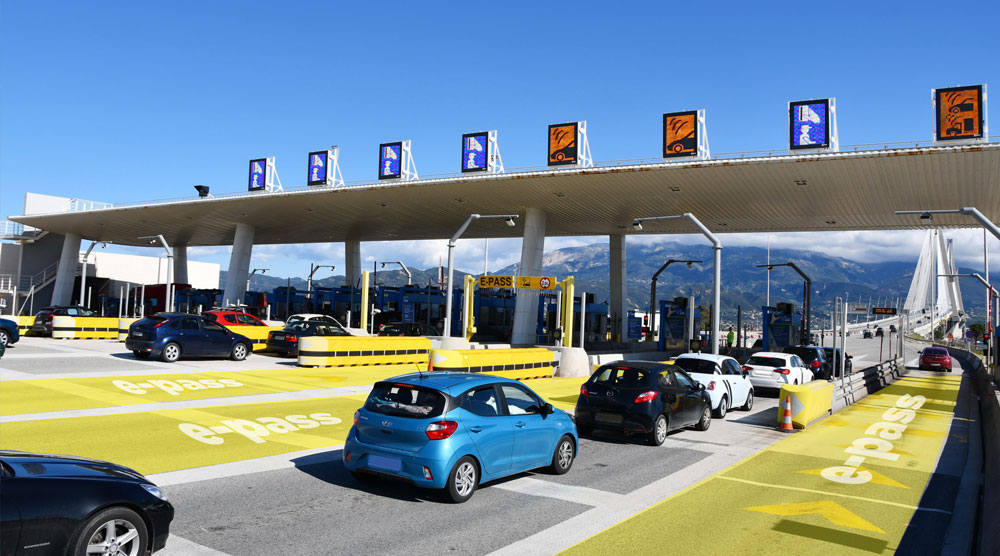
The Concession Contract provides for maximum tolls to be levied by the Concessionaire. Below these levels, the Concessionaire is fully responsible to market its tolling policy.


What is a cable stayed bridge?

Two piers and one beam form the simplest bridge. Such one beam bridge currently achieves a maximum single span of 250 meters. 
When necessary, piers and beams are added to form a continuous span viaduct without limited length, the world record being the Lake Ponchartrain causeway in the United States with about 38 km length. 
Another traditional technique consists in suspending the bridge to two cables anchored at crossing ends. It results in a supple structure often used to cross deep gorges where no pier can be built. 
In the nineteenth century, men had been looking to span longer distances and devised to raise the cables to the top of pylons to form suspension bridges. This technique achieves the longest single span, the world record being the Akashi Kaikyo in Japan with a single span of 1,991 meters. 
 However, when sufficient anchorage is not available at crossing ends or for economical reasons, the cable-stayed technique developed in Europe during the sixties, may be used. The deck is then suspended through stay cables to pylon in a balanced and aesthetic way. 
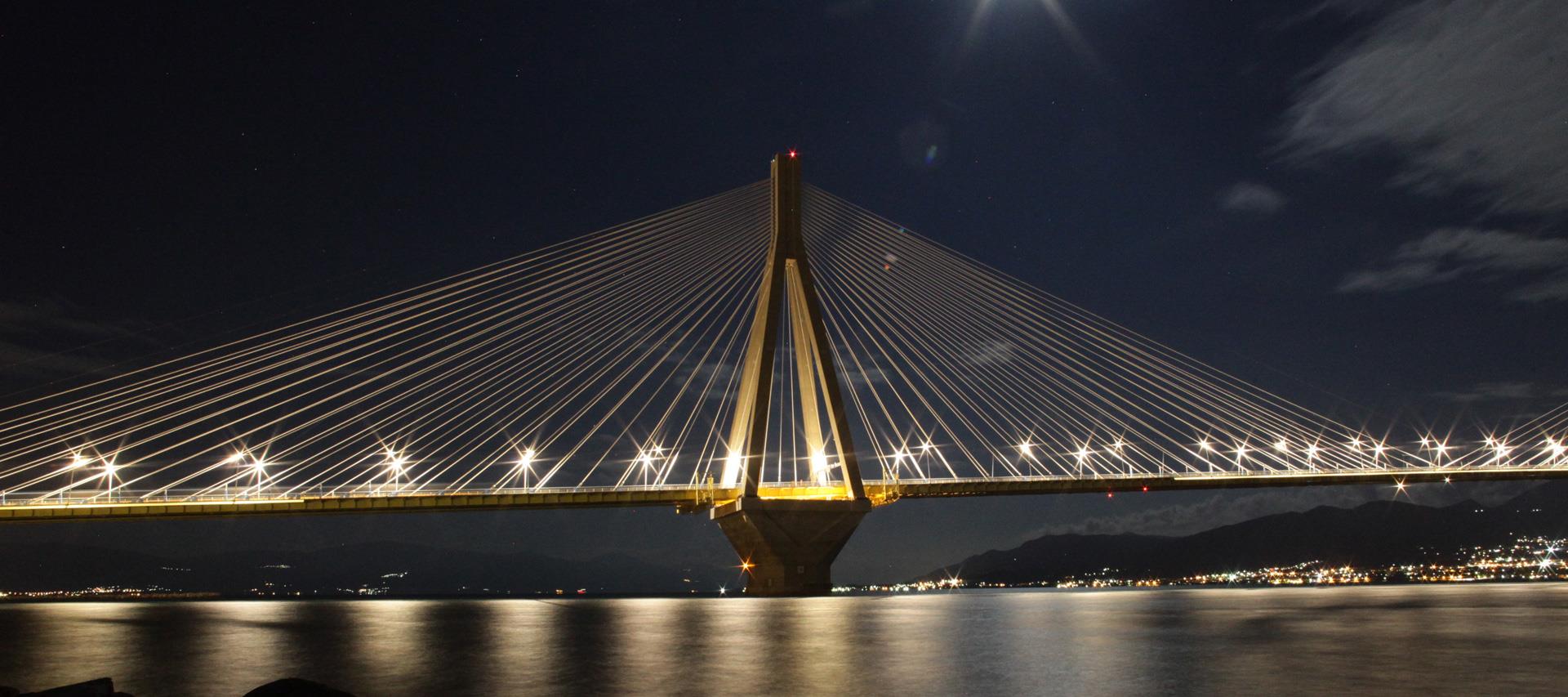
 The equilibrium of the structure lies on each and any pylon and thus, cable-stayed bridges may indifferently have one, two, or more pylons, as for the 4-pylon Rion-Antirion cable-stayed bridge. 
 
Physical data
 
First, the bridge has to span a stretch of water of some 2,500 meters.
Moreover the physical features of the strait present an exceptional combination of adverse conditions, which makes this project unique:
water depth up to 65 meters, absence of stiff seabed subsoil, strong seismic activity and possible tectonic movements. 
The seabed profile presents steep slopes on each side and a long horizontal plateau about 60 meters below sea level. No bedrock has been encountered during investigations down to a depth of 100 meters below seabed. Based on a geological study, it is believed that the thickness of sediments made of thick layers of clay mixed in some areas with fine sand and silt is greater than 500 meters.

In addition when defining the specifications for the bridge, the Greek State has imposed stringent design seismic loading: a peak ground acceleration equal to 0.48 g and a maximum spectral acceleration equal to 1.20 g between 0.2 and 1.0 second. As an example, these specifications are more severe than the accelerations recorded on 17 August 1999 during the Izmit 7.4 Richter scale earthquake.

At the end of the 20th century, the question still was "how can be built a bridge here?"


The design concept

The critical factor for the design of the bridge lays in the seismic approach, though the bridge also has to sustain the impact of an 180,000-ton tanker sailing at 18 knots, high speed winds and less importantly, the passing by of cars and trucks, its first purpose...The possible tilt in case of earthquake has been the major concern. A thorough analysis showed that large shallow foundations were the most satisfactory solution subject to the reinforcement of the top 20 meters of seabed subsoil. This will be achieved in designing 90-meter diameter pier bases and placing metallic inclusions in the seabed subsoil. In addition structural isolation systems mitigating seismic forces were systematically researched. One of the main findings, and definitely the most innovative, is a 2,252-meter fully suspended continuous deck, moving as a pendulum during an earthquake and permitting significant movement between adjacent piers.
 
The bridge description
The bridge consists of:
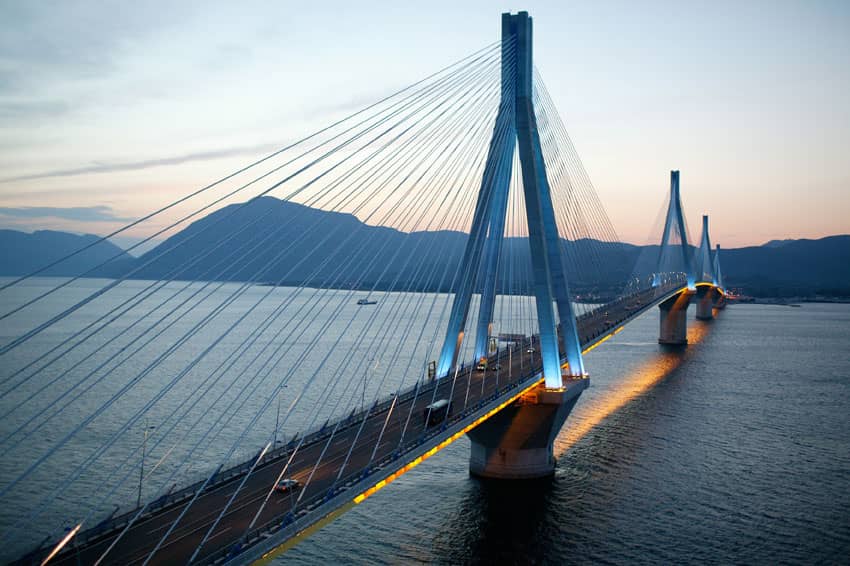
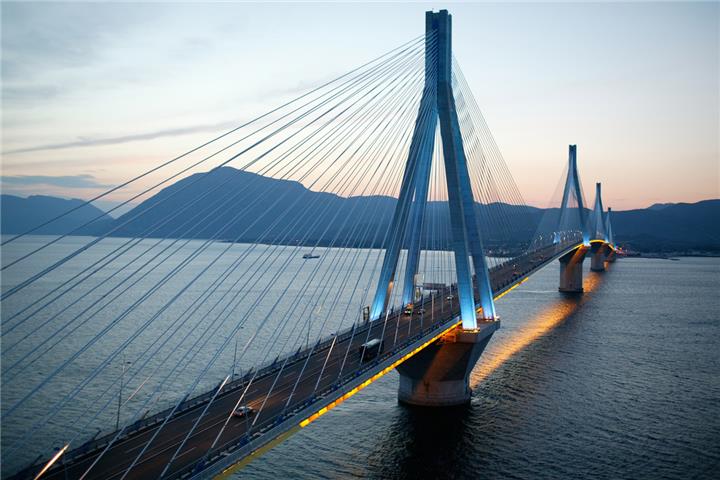
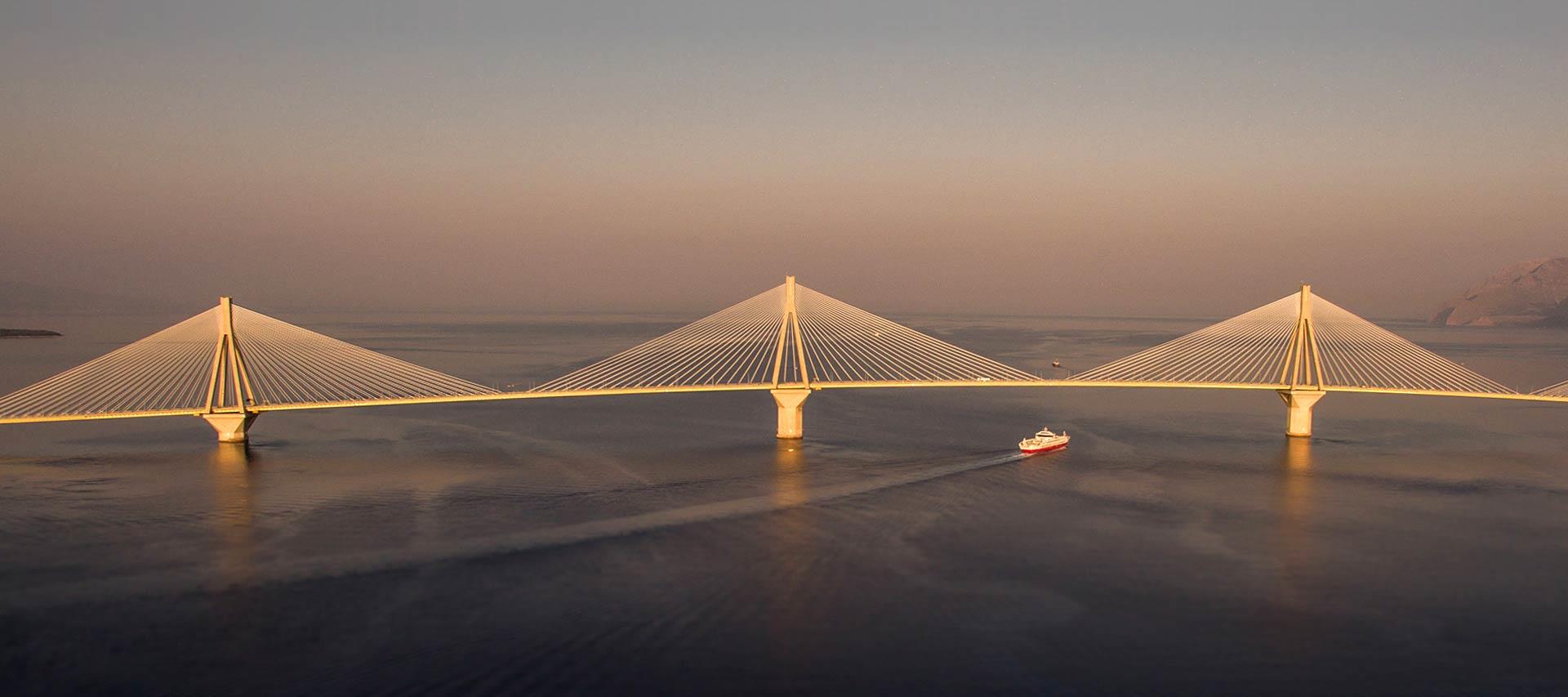
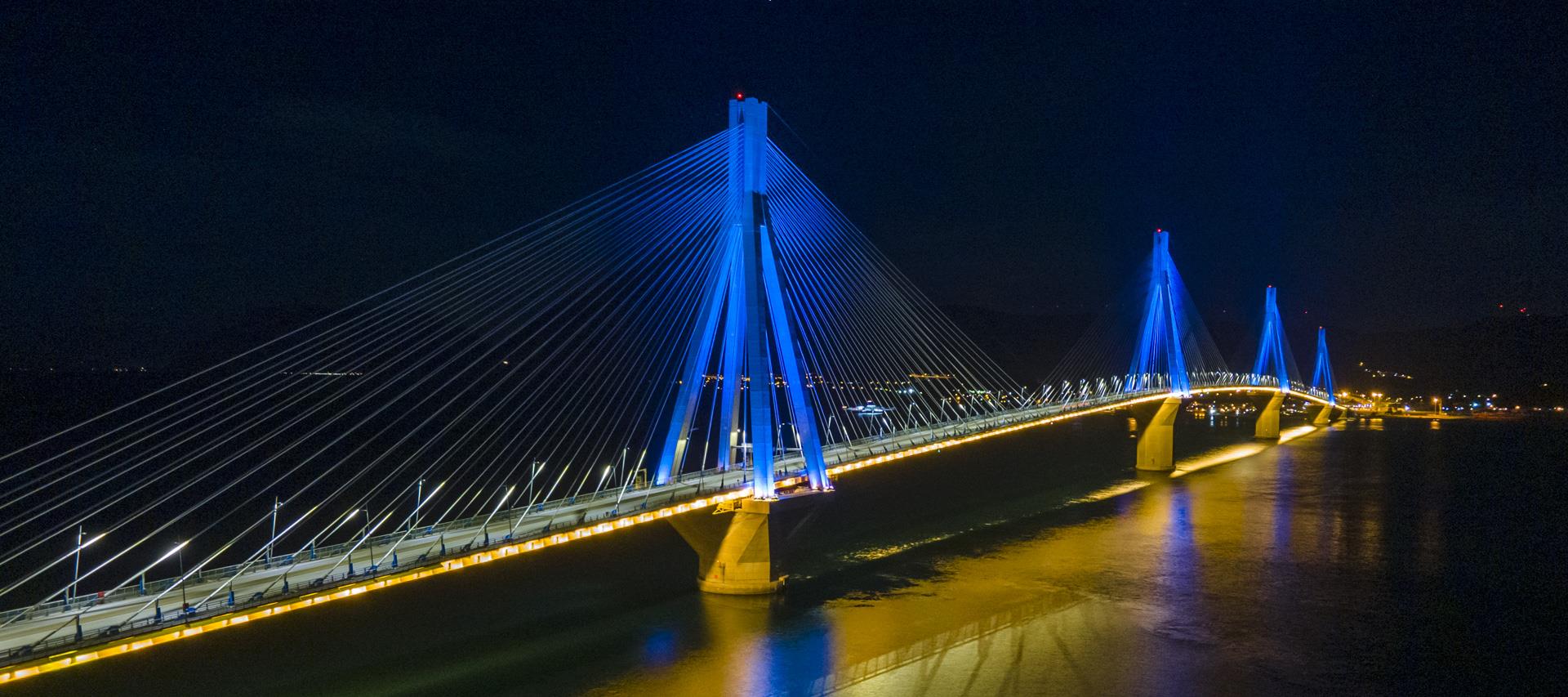
a 2,252 meter long 4 pylon cable-stayed bridge with a span distribution equal to 286 meters, 560 meters, 560 meters, 560 meters and 286 meters,
two approach viaducts, with 392 meters on Rion side and 239 meters on Antirion side.
The upper soil layers are reinforced with inclusions, which are 2 meter diameter hollow steel pipes 25 to 30 meters long driven at a regular spacing of 7 meters. About 200 pipes are driven in at each pier location. A three meter thick properly leveled gravel layer tops them. Foundations are 90-meter diameter reinforced concrete caissons resting on the gravel layer.
 
A cone whose diameter ranges from 38 meters to 26 meters forms the lower part of the pier.
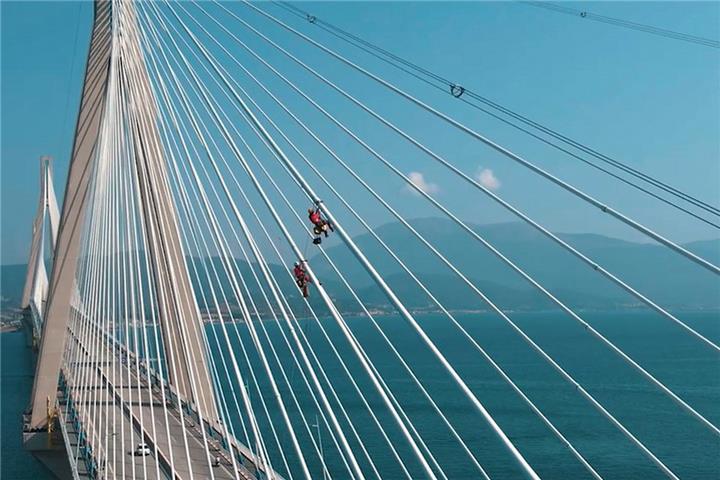
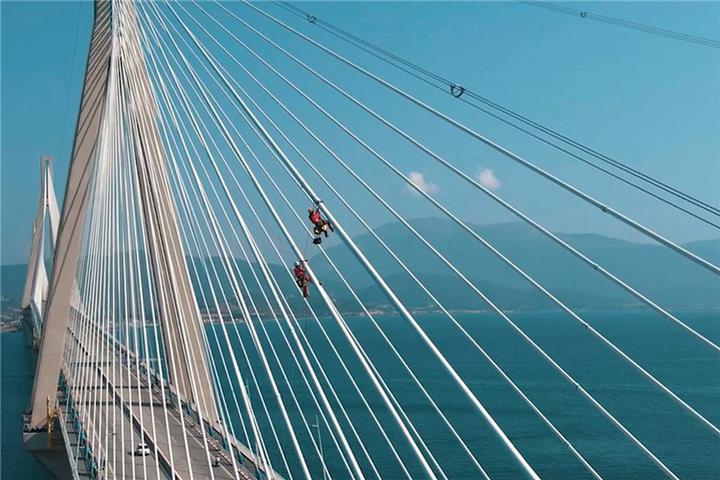
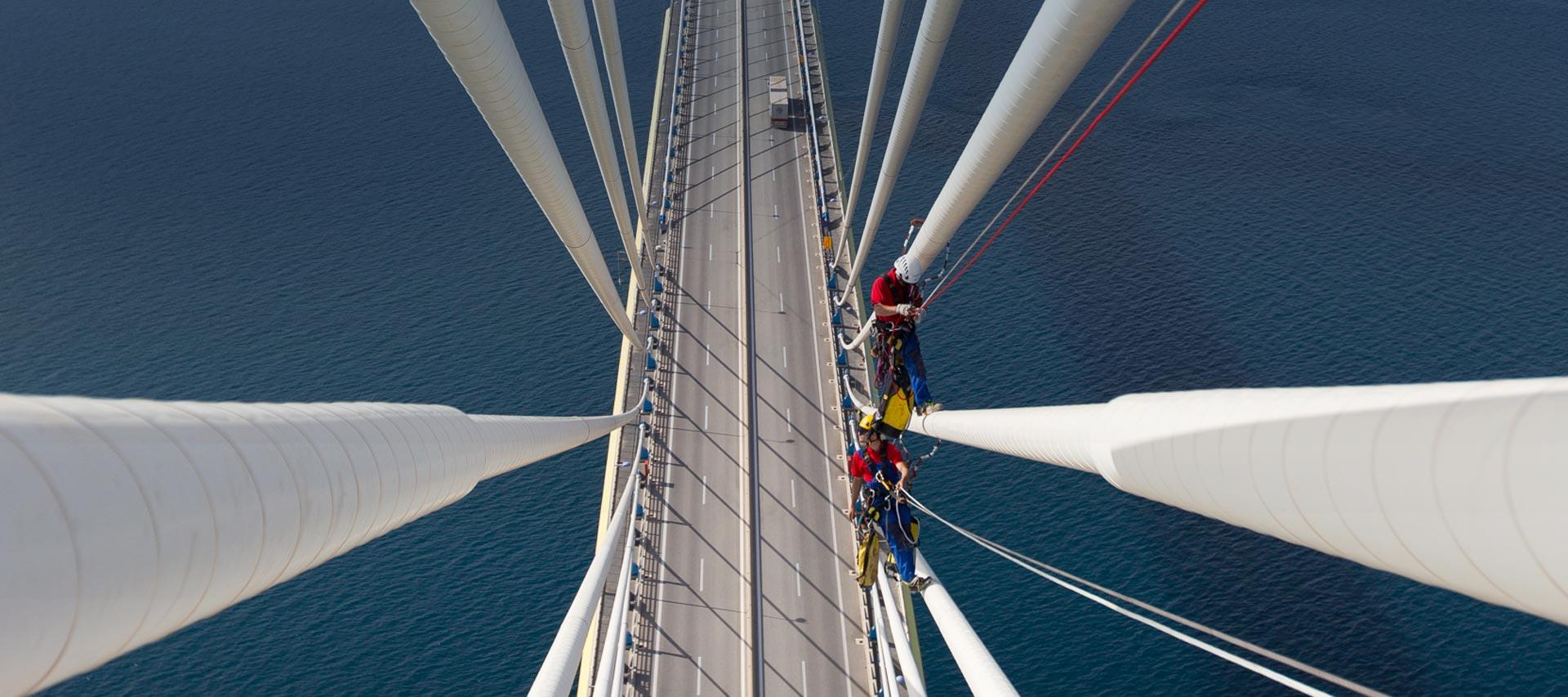
The upper pier shaft bears a reverse pyramid with a height of about 15 meters and a square base of 38-meter long side. Each pylon is composed of four reinforced concrete legs with a section of 4 by 4 meters, embedded in the pylon head to form a monolithic structure. The stay cables are in inclined arrangements, with their lower anchorage on deck sides and their upper anchorage in the 35-meter high pylon head. They are made of parallel galvanized strands. The thickest cable is formed of seventy 15mm strands.
 
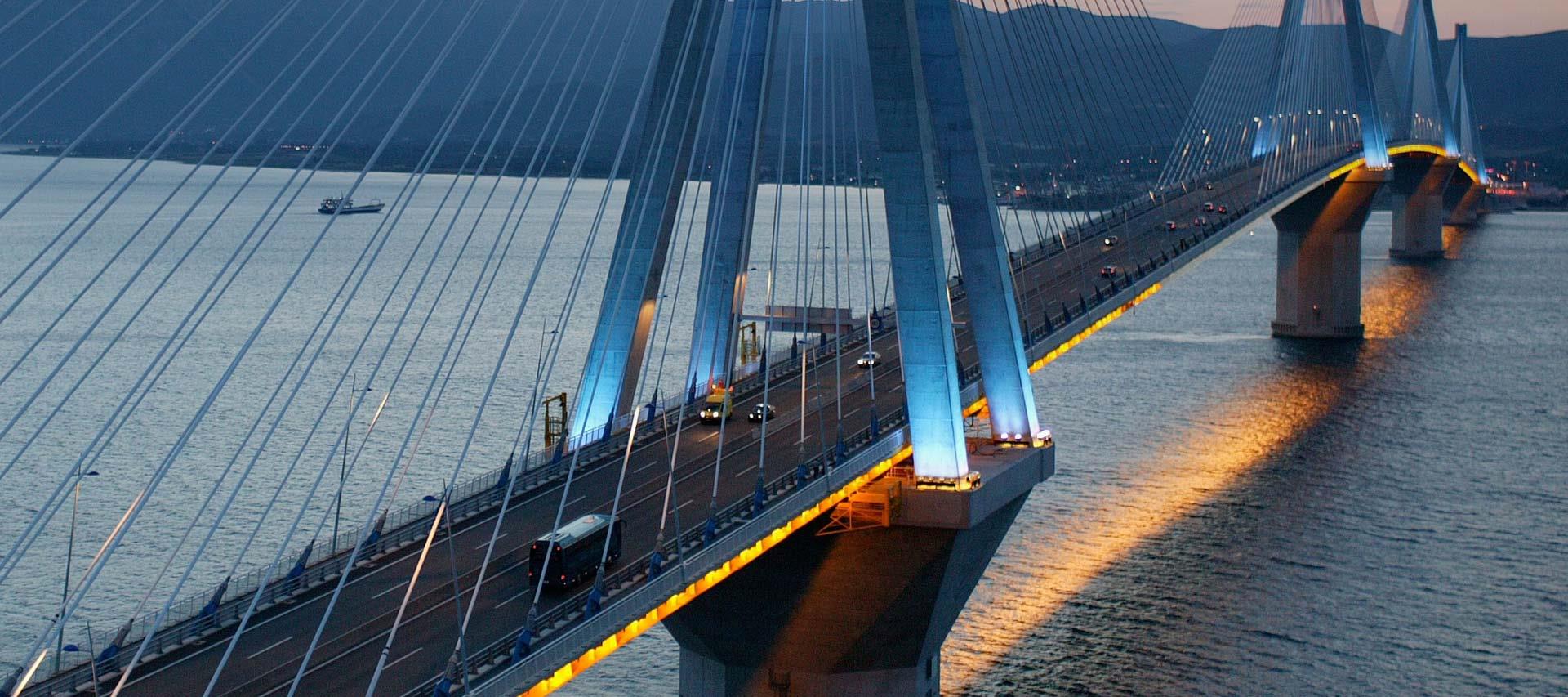
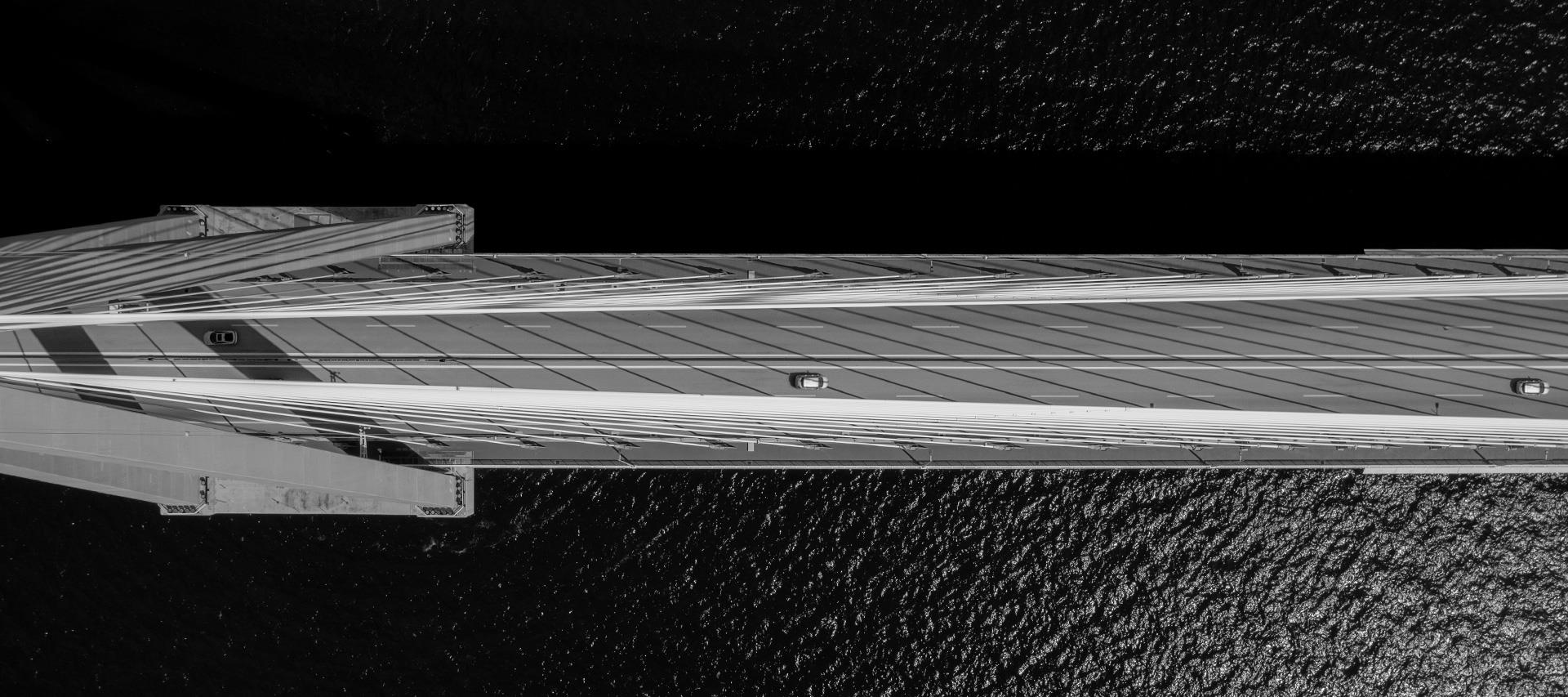
The deck is 27.2 meters wide with two traffic lanes plus safety lane and a pedestrian walkway in each direction. It is a composite structure with a steel frame made of two longitudinal 2.2-meter high plate girders on each side and transverse plate girders spaced every 4 meters. The top slab is made of precast concrete panels.The deck is continuous and fully suspended for its total length. Four damping devices connect the deck to the top of each pier and limit the pendulum movement of the deck during an earthquake. The dynamic relative movement during the design seismic event is in the order of ± 1.30 meter while velocities may exceed 1 meter per second.
 
On each side, a monumental transition pier links together the deck of the cable-stayed bridge with the deck of the approach viaducts.
 
The marine equipment
The Rion-Antirion bridge state of the art design does not limit to the bridge itself but also comprises the marine equipment.
A tension-leg barge has been custom-made to perform the various marine works including the seabed dredging and the driving of inclusions. It is a world "premiere" to have applied this principle on a movable equipment. Her name is LISA A.The concept is based on active vertical anchorage to dead weights resting on the seabed. When in place, the tension in these vertical anchor lines is adjusted in order to give the required stability to the barge in function of the sea waves and the loads handled on board. Moving to another location is achieved in increasing the tension in the anchor lines, the buoyancy of the barge allowing the dead weights to be lifted from the seabed.


Design

COMING SOON


Construction methods

COMING SOON


A pylon view

A typical structure is 220 meters high from sea bottom to pylon head. The piers are lying in around 60 meters of water. Pylon bottoms ranges from 25 meters to 45 meters (for the two central pylons) above sea level, leaving a shipping clearance below the deck of 52 meters in the middle of the strait. Pylons rise by 115 meters to a maximum height of 160 meters above sea level.


Comparison to famous bridges

Comparing to scale the Rion-Antirion bridge with world famous bridges demonstrates the magnitude of the project undertaken.
The Tatara bridge in Japan and the Normandy bridge in France are the cable-stayed bridges with the longest spans in the world (respectively 890 meters and 856 meters). With a reference span of 560 meters, the Rion-Antirion bridge shall rank in the top 10 list of the world longest span for cable-stayed bridges. However with its 4 pylons (compared to the usual set of 2), it is the cable-stayed bridge with the longest suspended deck (2,252 meters) in the world.
Such outstanding deck length outperforms the total deck length of the well-known Golden Gate suspension bridge (1,966 meters)


« back Λίστα Περιεχομένων (Site Map)


GEFYRA S.A.
2, Rizariou street – 152 33 Halandri
tel: + 30 210 68 58 196
fax: + 30 210 68 58 786
E-mail info@gefyra.gr
GEFYRA LITOURGIA S.A.
300 20 Antirrion – Aetoloakarnania
tel: + 30 26340 39010
fax: + 30 26340 39049
A project co-financed by the European Union


© 2008, Με την επιφύλαξη παντός δικαιώματος
Αποποίηση ευθύνης
Produced by ôlyvon | INCOM CMS